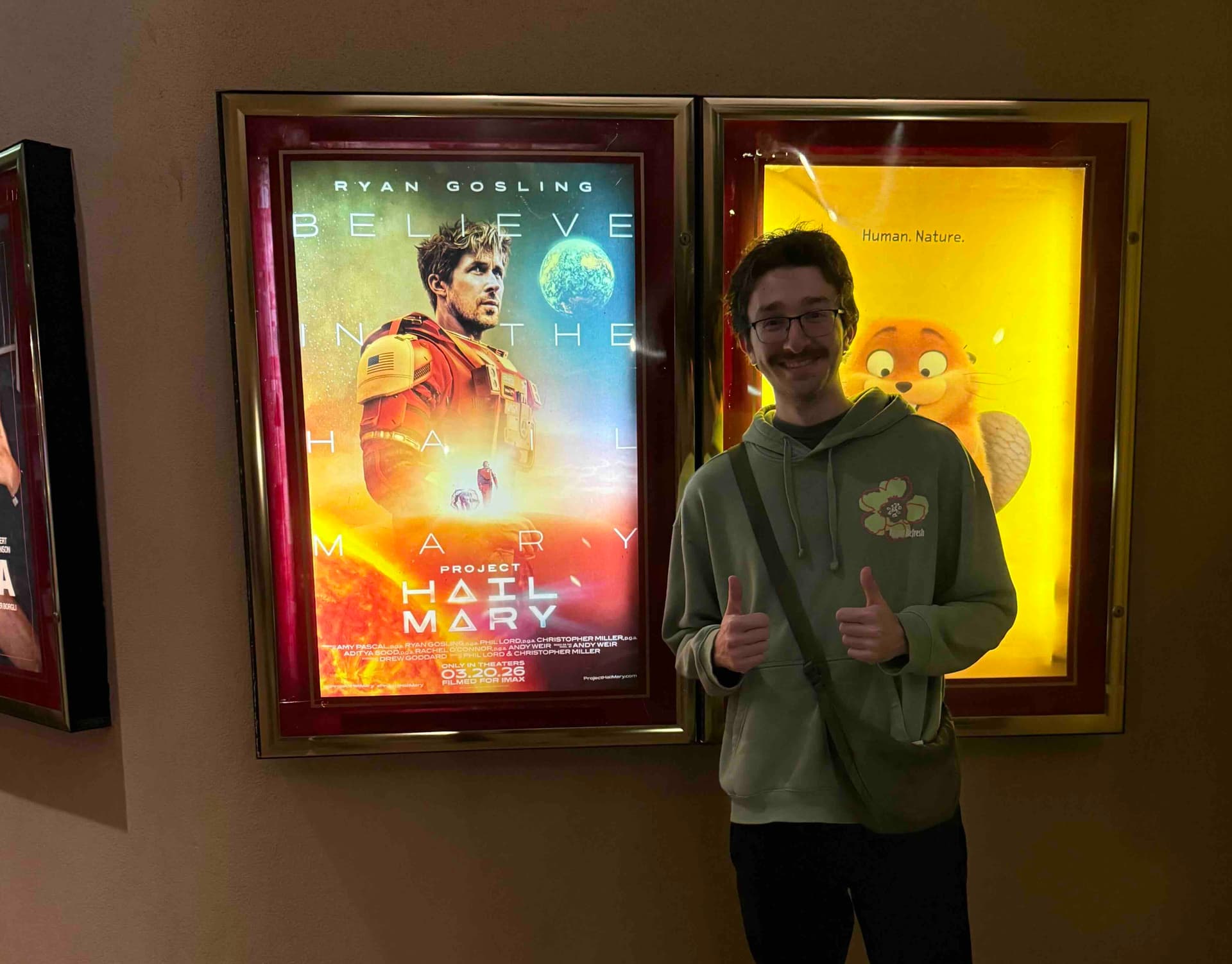
Project Hail Mary and Why Fiction Matters
I read Project Hail Mary by Andy Weir the summer before my freshman year of college. I was just getting back into reading for fun, and I thought that book would be a good thing to read for the first couple months of college. I started reading it September 9th, 2021. I moved in to my dorm on September 14th, 2021. When do you think I finished the book?
September 12th, 2021. I read that book non-stop for 3 days straight. It was part of what reignited my love for reading, something that became a big part of my college experience.
I distinctly remember sitting on a couch at my first club retreat freshman year, a little nervous, escaping into a book. Sophomore year, getting to class early so I could read a couple pages. Junior year, yelping with excitement from a particularly good scene, causing my roommate Jacob to walk in and ask what was going on. Senior year, rushing out of the CS lab because a book I was reading in there had me near tears. My fifth year, starting to write long book reviews for several books that disappointed me, which snowballed into me writing these essays.
I like to think of Project Hail Mary as the start of all that, the first time I had really loved a book in years. I loved books when I was a kid, so much so that teachers had to confiscate books from me because I would read during class. As I grew up, though, my teachers wanted me to read more non-fiction, as part of me maturing. High school came along, and we were forced to read so many books, some of which I loved (The Great Gatsby, for instance), and some of which were just straight up awful (Great Expectations and Madame Bovary, sorry Dr. Wilson, those were not fun reads for a 16 year old). The problem was that reading became less of something I did for fun and more something I did as work, and I fell out of love with reading in my free time.
There's some sort of weird stigma with reading. If people do read (which is rarer and rarer nowadays, with the literacy rate in the U.S. dropping at an alarming rate. That's a topic for another essay, though), I feel like they think fiction is a waste of time, or something you do exclusively for pleasure. People seem to think the only reading that does you any good is self-help books or non-fiction. This attitude extends to movies, shows, everywhere. If it's not realistic, it's somehow childish. To become "mature", you have to consume non-fiction.
This attitude is dead wrong, and it will leave us all worse off. I've believed in the power of fiction for a while, but watching the movie adaptation of Project Hail Mary tonight showed me just how important it can be.
Fictions allows us to see worlds that don't exist. More importantly, it allows us to see worlds that could exist, opening our minds up to possibilities we might not have seen before. This is why a certain sub-genre of fiction is called "speculative fiction", because it speculates on what reality could be like.
Major spoilers for Project Hail Mary ahead.
In a world where we are more divided than ever, where the people in charge would like us to see others as less than human, Project Hail Mary offers a different view of approaching the Other. The story is in part about first contact, but not between the leader of the human race and the leader of the aliens. It doesn't start with the aliens attacking us. First contact happens between two mostly regular people.
Ryland Grace, the main character, is initially scared of the alien, Rocky, but that fear is quickly replaced with curiosity. Rocky doesn't look humanoid at all, but instead of seeing something different than himself and immediately trying to kill it, Ryland attempts to communicate. Both of them are far from home, doing their best to save their planets. Both of them are alone.
They spend the rest of the movie working together, learning how to speak with each other along the way. One of the most important moments of the whole story is when Ryland begins to understand why Rocky wants to watch him while he sleeps, and how he begins to reciprocate, overcoming his skepticism of Rocky's societal norms.
There's more to the story than that, but a fundamental part of it is how despite all the obstacles standing between Rocky and Ryland (language, survivable atmospheres, societal knowledge), they are able to become friends. They consistently risk their lives for each other. Moreover, Ryland eventually decides to sacrifice his one chance to go home, coming back to save Rocky and his people when he realizes Rocky won't be able to make it home without his help.
The primary speculation I am referring to here is the idea that a world can exist where we aren't so scared of the Other, where we don't kill people just for being different from ourselves. A world where we are willing to give something up for the sake of the Other, rather than just take and take and take.
The movie offers up a different primary lesson, though, that sets the tone for the whole story. Even when the whole world is counting on him, Ryland is never able to believe in himself. He tries his best anyways, and it's other people's belief in him that allows him to succeed in the end.
It's an interesting scenario, where he likely wouldn't be able to do it without their faith in him, making their faith unjustified, but that same unjustified faith is what enables him to do what he does, saving two civilizations in the process.
This is where I am reminded of something I said in my Sun Soaked Days essay, "There's a difference between believing in a thing and believing that thing is true. This is the core of faith of all kinds, believing despite lack of proof, believing because the belief itself is what matters."
This is what makes fiction so valuable, its ability to make us believe that a better world is possible. Believing a better world is possible is the first requirement for making it happen. The stories make us reach further, imagining not just what is but what could be. It inspires us to do better in our own lives.
Sure, non-fiction stories are able to inspire us too, and I am not saying consuming non-fiction media is unimportant. It certainly is, and being up to date on world events is an extremely important part of making informed decisions when voting.
Regardless, for at least the next couple weeks, when I'm low on hope, the first people I'll think of are Ryland and Rocky. Their story might not be real, but the message certainly is.
Subscribe for more writing